Showing posts with label photo. Show all posts

Saturday, 5 July 2008

Plagiarised photos

I found an interesting post at PDNpulse about Blog readers catch Plagerizing Photographer.

It was quite interesting as the readers of the blog identified that a photographer was copying photos taken by other photographers.  there was an uproar (maybe an overstatement) and the photographer has taken the photos down.

Makes you wonder about microstock.  Do a search for jumping fish and you will find photos taken by Yuri, G Cohen, khz, velychko, K Brown, mikdam, lisagagne (I stopped looking but I am sure there were more and that was only searching shutterstock and istock).  Did anyone notice two of the biggest names in microstock in that list. 

None of microstock versions that I linked to above are exact copies like the ones listed in blog above, but they are very close.  So how far can you go with derivative works?

    
Shutterstock
Royalty Free Images

Friday, 4 July 2008

Do professional photographers struggle with microstock?

Lee Torrens has posted a great blog on the 10 reasons why professional photographers often struggle with microstock.  Lee makes some great points so go have a read.  It is getting some good comments as well. 

I think the biggest one is #10 They want microstock to fail.  Of course they do.  They have gone from selling photos for $100s if not $1000s of dollars and are now getting 30c.  But in some cases the photos isn’t worth $100.  A picture of an apple is not worth that much and that has stopped small businesses using photography in their publications (see here)


Lees article was also picked up at PDNPulse with their blog “Do professionals want microstock to fail” which despite the title, focuses on reason #4 Do you know who I am? and discusses the point that all the reputation and respect they have built up in the industry disappears when they have to compete on an equal footing with amateurs with point and shoot cameras (my words not the articles).


Shutterstock
Royalty Free Images

Monday, 23 June 2008

Find your photos online with Tineye

Want to know where you photos are online?  Well you could try searching the net yourself, or you could use TinEye

Tineye is still in private beta but you can apply for an invite (mine came through in a few days).  Once logged in, you can give TinEye your photo, and it will search the web for it.  A couple of points to note:

  • They have only indexed a small portion of the web so far (about 750 million images -  compare that to over 4 billion indexed by Google).  I did a few searches on my photos and found they didn’t pick up all instances where I knew it was online.
  • It doesn’t require an exact match.  This can be good in that it will find photos where they are slightly different (ie. with or without watermarks) or images manipulated (ie. Photoshopped, cropped, converted to B&W etc).

While it isn’t perfect at the moment, it is a great tool to have in the toolbox. 

It would also be very help for designers - Going to buy a photo but don’t know where else it has turned up? Do a search to avoid situations like this and this.  There is also a Firefox extension (and IE) so that you can right click on a photo on any website, select search and it will find all other indexed matches.

Check out their video:

Other commentary:

Techcrunch

Microstockdiaries

JMG galleries

Royalty Free ImagesShutterstock

Sunday, 22 June 2008

Microstock’s main market don’t use photos

iStock commissioned a survey of small and medium businesses in the UK to determine how they use images in their marketing.  The key finding are:

  • 27% of SMBs don’t use imagery in their business at all
  • Of organisations who use imagery, 51% use imagery on their website, 40% use imagery in presentations, 31% use imagery in marketing & advertising collateral and 14% use imagery in the office interior design
  • 71% of SMBs use photography more than other types of imagery
  • The majority of SMBs, still go in-house to source images, with 59% taking photos with their own camera, compared with 40% using online stock photography and 31% commissioning photography

See here for more detail

Royalty Free ImagesShutterstock

Wednesday, 11 June 2008

New Article on Getty and iStock

As part of filings made with the SEC, Getty has had to disclose some information which it would normally keep secret. 

One interesting quote is:

"The introduction of microstock has significantly increased the availability and usage of stock imagery. The advent of affordable high-end digital cameras and broadband Internet access has enabled semi-professional and hobbyist photographers to greatly expand the supply of digital stock imagery, and low microstock prices have put stock images within reach of far more potential customers. The primary consequence of the introduction of microstock has been to open the creative stock imagery market to new segments of users. Small and medium-sized businesses represent a large customer segment for which stock imagery was previously too expensive. For example, a dental practice might now include a microstock image of a boy brushing his teeth on its mailers to patients, whereas before it might have only shown a drawing of a tooth and toothbrush (or perhaps just a message in formatted text) on its appointment reminders because of the relatively high cost of stock imagery. Microstock also enables traditional stock image users to cost-effectively use stock images for interim uses such as storyboarding, customer pitches and internal presentations. Previously these applications would have contained lower quality, freely available images, or hand-drawn sketches. Customer research suggests that approximately 40-50% of microstock demand is comprised of entirely new end-uses, such as those described above. As a result of the combination of new customer segments and new end uses, volumes of microstock images are 15-20x greater than traditional stills.

Another interesting part is a comparison of sales volume between Getty and iStock, the market leader of macrostock and microstock respectively:
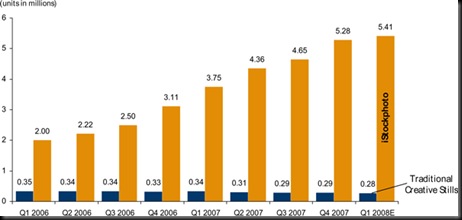
Getty sales graph

More details at this article from pdn.

The filings at the SEC are found here.

Shutterstock Royalty Free Images

The average American/Kiwi/Australian family

NZ budget photo The NZ government put out a brochure today setting out the benefits of its latest budget.

It was discovered however that the picture used (left) was bought from from iStock. To me that isn’t a problem.  If the government decides to spend $20 for a photo rather than over $1,000 for a custom photoshoot that is a good idea.

The problem is that the photo is of an American family, not a New Zealand family.

Australian Affordable house photo

To make matters worse for the NZ government, the photo has already been used by the Australian government to advertise their affordable homes program (right).

To things to take out of this:

  1. the perfect stock photo is one that can be used in a variety of circumstances and by a variety of buyers.  This photo has been sold over 2,000 times and can be used in any western country.
  2. microstock photography can create problems from a buyers perspective when the photo is recognisable in other peoples campaigns.

Link to article


[EDIT - it has even been used as an irish family]

Shutterstock Royalty Free Images

Tuesday, 3 June 2008

New subscriptions at Fotolia

Fotolia has just announced a new subscription plan where you got as low as 23c for each download. After outrage on the forums, both on Fotolia and on independent ones, the price was increased to ... wait for it:

The new commission structure will be as follows.

Ranking Payment / Download
White 0.25 Credit
Bronze 0.26 Credit
Silver 0.27 Credit
Gold 0.28 Credit
Emerald 0.29 Credit
Ruby 0.30 Credit
Sapphire 0.31 Credit
Diamond 0.32 Credit

Thats right 25c to 32c. Compare this to Shutterstock's latest pay rise (33c to 38c except for the smallest users) and you see this isn't a great offer to the photographer.

I am not happy about this, but will see how the sales go.
Fotolia
Shutterstock

Monday, 2 June 2008

Microstock photography results for May 2008

Another slow month. Earnings down again but still tracking ahead of last year. Interestingly, last year, sales dropped in the period from March to May and then rose month on month all the way through to October. It will be interesting to see if this happens again though it does look line the trend in 2007 was caused by no uploads during the March to May period followed by a couple of big upload sessions.

I could replicate this as I have a few shots ready for upload so it is just a matter of prioritising microstock which I haven't been doing since my big trip (Basically I have too many photos that I am just overwhelmed of where to start). Winter is here now so hopefully I will get some time to do it.

The other thing that is interesting is how different sites do better for no apparent reason. I have done nothing in the past year yet StockXpert had a great month last month and dreamtime had a great month this month. As long as each month a few sites do well, I dont complain if it isn't the same ones.

Below are percentages for the month to show how I have been going:

15% shutterstock
21% dreamtime
9% Fotolia
27% istockphoto
6% bigstockphoto
8% 123RF
14% StockXpert
0% Featurepics


Previous results for 2008:
April 2008 Earnings
March 2008 Earnings
Feb 2008 Earnings
Jan 2008 Earnings

Shutterstock
Royalty Free Images

Wednesday, 1 August 2007

Microstock photo results for July

Shutterstock
July was a best ever month for me thanks to great sales at shutterstock , istockphoto , StockXpert. The increase at shutterstock was expected as I have uploaded a number of new images there over the past two months and have really felt the benefit of the "new photo" effect. istockphoto was a supprise as it really took of this month for no apparent reason. This has happened before (in March) and wasn't sustained but hopefully it will be this time. All the other sites were a bit disappointing but the season pros were expecting the "normal July slow down" (caused by holidays in the US??) so maybe it was effected by this. August is quite a popular holiday time in Europe but hopefully there wont be an August slowdown as well as I have no Christmas shots to enjoy the Christmas rush which lots of people enjoy.

Sales are creaping back at Fotolia following the relaunch of its site. Sales dropped of considerably but in the second half of July, they were almost back to normal. They are still experiencing issues with there search engine so hopefully they will get this fixed shortly, or even better, the buyers find my photos at sites with a higher commission like StockXpert.

Below are percentages for the month to show how I have been going:

34% shutterstock BEM
12% dreamtime
5% Fotolia
23% istockphoto BEM
3% bigstockphoto
4% 123RF
16% StockXpert BEM
1% Featurepics
2% LuckyOliver

I am off on holiday shortly for a few month so posts will be very intermittent if at all. Hopefully i will get some great shots.

Shutterstock
Royalty Free Images

Tuesday, 5 June 2007

Microstock article in the NY Times

The New York times has just published an acticle on microstock. It is just a puff piece and doesn’t offer up to much info. However, it does provide some interesting info on a few of the pro’s who do Microstock – Lisa Gayne, Kelly Cline and Stephen Coburn.

Extracts from the article (link to full articel below)

When Are Photos Like Penny Stocks? When They Sell.
By ERIC A. TAUB
Published: June 5, 2007
It sounds like a late-night TV come-on for a phony get-rich-quick scheme. But in this case, it might just be true.

Thanks to the Internet and digital cameras, thousands of semiprofessional photographers are now selling their shots through so-called microstock Web sites to customers around the world.

Traditional photographic stock companies charge several hundred to several thousand dollars per image. Microstock prices can be as low as 25 cents, and payments to photographers are even lower, often not much more than pennies per sale.

But some photographers are making significant incomes from their pictures, making up in volume what they have lost in per-shot commissions. And that, in turn, is affecting the business of some mainstream professional photographers.

“Maybe a $300 photo for a pamphlet distributed to 300 people is not worth $300,” said Jon Oringer, the founder of Shutterstock, a four-year-old microstock agency.

Shots of dogs and cats are generally not welcome, while “lifestyle” photographs — pictures of people at work and play — are usually top sellers. Other subjects of interest include food, sports and fashion.

Keeping one’s pictures confined to one site may not be a good idea, if the site attracts few customers, or becomes known for specializing in pictures of sheep while you are hoping to sell shots of toothpaste.

“We did not want to limit the ability of photographers to earn money,” said Tim Donahue, the founder of Big Stock Photo, which does not offer exclusivity.

Some photographers say exclusivity works. The same picture on multiple sites may have different prices. By being exclusive photographers can more easily trace those who might be misusing their work, either by using an image — on, say, a coffee mug — without buying rights to it or by stealing a concept they like, recreating a photograph and selling it as their own.

Those who are doing well selling their work on microstock sites have done their homework: they have figured out what type of photographs a site specializes in, what types of pictures sell and whether the commission is sufficient.

Lise Gagné of Quebec specializes in business shots, one of the most popular genres. Ms. Gagné, who has been shooting commercially for five years, earns more than $100,000 a year selling her work exclusively through iStockphoto.
“I like iStock’s sharing spirit,” Ms. Gagné said, referring to the extensive discussion groups and other client aides the site provides. “It’s a matter of being fair. You don’t have to go elsewhere.”

Because volume matters in microstock sales, a large number of shots must be uploaded. Ms. Gagné currently has 4,900 photographs available for sale on the site and adds 5 to 20 more each week.

Kelly Cline, a Seattle-based food photographer, has uploaded 1,363 images to iStockphoto, and her work has been bought 68,215 times. Significant payments began to arrive once she had 500 to 600 images in her portfolio, Ms. Cline said, adding, “If you upload more, it’s like shooting arrows in the air.”

Today, she said, she earns about $70,000 a year, 60 percent of her income, from microstock sales, and she remains an exclusive provider to iStockphoto.

But Stephen Coburn, a Web designer at Adobe Systems who began photography a few years ago as a hobby, said he would never use one microstock site exclusively. “I’d feel nervous about putting all my eggs in one basket,” he said.

Mr. Coburn supplies shots to five microstock sites, shooting people, objects and interiors. With 3,500 photos posted to the sites, he earns, on average, $6,000 per month.

Michael Shake, a tool-and-die maker in Toledo, Ohio, uploads pictures to 10 sites and earns $1,000 a month for his work. Specializing in shots of houses and new cars, he sells his work to real estate agents and car dealers looking for appropriate illustrations.

Not everyone is enamored with microstock Web sites. Professional photographers see the sites’ growth as diluting their own incomes.

“This is the death of beautiful photography,” said David Skernick, a professional photographer in Los Angeles who does not use the sites. Because of the low prices and large volumes of material, “now clients accept anything.”

Still, railing against the sites is about as useful as hoping cellphones will go away and phone booths will make a comeback
.

Link

Shutterstock

Monday, 4 June 2007

Fotolia v2 - upgrades and payrise [updated]

Fotolia
[update - Fotolia have delayed the launch of their new site. They hope to get it up this weekend now. At least they postponed the upgrade rather than go through with it in an imcomplete state. Hopefully it will be up this weekend as it has been painfully slow their for the past week.]


30/5/2007 - The long awaited upgrade to Fotolia is nearly here.

The biggest news is that there is a payrise. While commission % are not changing, 1 credit which use to be worth US$1 is now worth US$1.36. Time will tell whether this effects the amount of downloads (ie. people buy less because it costs more) but it shouldn't which means that we get a 36% payrise - GREAT!

Other changes at Fotolia include more servers, a recode of the site, scrapping the exclusive buy out, a Database clean out and vector support. There have been a few complaints about the speed of the website (which can be extremely slow - very off putting for buyers - so hopefully this upgrade will address this issue.

I will give some more feedback once it is online.

From Fotolias blog:

Exclusive Buy Out license

Due to fraud issues and declining buyer interest, we have removed the Exclusive Buyout licenses. New licensing models will be introduced soon

Credit Value

We finally feel it is time to raise our prices however it will not be a drastic change. 1 credit will now cost $1.36 . This value is more accurate and equal to our other international countries who use the Euro as a basis of payment. This should be good news for photographers who will now see a 30% increase in commissions overnight.

Data base clean up

It is time for us to clean the database. Since the beginning of Fotolia, the quality of images has really increased. We have received millions of images and it is now the time to clean the database and give a chance to new images that sell as good as the oldest ones. Quality is and always will be the key to attract good buyers. After the launch of V2, images with no sales for 18 consecutive months will be removed from the Fotolia database.

Prices Changes

To simplify and improve the efficiency of the customer experience we have developed a new pricing system in V2. This new pricing model will bring in more customers and thus more commissions for all photographers.


New version

The Fotolia team is very excited about the V2 release. We have totally rebuilt the core code and infrastructure of the Fotolia website however maintaining pretty much the same design. V2 will increase stability, performance, and allow for new future opportunities. Searching, editing, and uploading have all been optimized to increase speed, accuracy, and performance. Some of the new features will include Vector support (SVG Files), image folder organization, and a flash upload system. Additional details will be published immediately following the V2 release to more fully describe the new features.

Fotolia

Friday, 1 June 2007

Dreamstime enters cellphone wallpaper market

Royalty Free Images
A press release was made on Thursday announcing Dreamstime was partnering with Boom Bucket to supply wallpaper to mobile phones.

The release and Dreamstimes website was short on details as to how this will actually work but I ahve always thought that cell phones where an large untaped market. You just have to look at the back of most weekly magazines (in the UK)that target teens/young adults to see that the market is taking off.

I will add more details as I find out.

Press release

Dreamstime partners with Boom Bucket Mobile to provide images that speak louder than words
Global Microstock Agency Enters Telecommunications Arena

Brentwood, Tennessee, May 31, 2007. Dreamstime and Boom Bucket Mobile, two global leaders in their innovative and extraordinary areas of business, have joined together to make images available no matter where you are. Dreamstime CEO and co-founder, Serban Enache, announced the microstock agency’s unique partnership with Boom Bucket Mobile to provide the best-of-the-best photos and images to Boom Bucket Mobile customers.

Boom Bucket Mobile is a mobile content provider that works with carriers, aggregators and other mobile content companies throughout the world. [In addition to the U.S., Boom Bucket Mobile has distribution in the EEU and North America, and is expanding operations in Asia and Japan.] Specifically, Boom Bucket Mobile offers on-demand access to wholly-owned, royalty-free mobile wallpapers, animations, ringtones, and video in the mobile content marketplace.

To meet the overwhelming demand for personalized cell phone screensavers, the partnership with Dreamstime will increase the available images to Boom Bucket Mobile customers to more than 1,000,000 at the very first day of the launch.

A seven-year old community agency designed with the user in mind, the simplistic features, friendly direction and easy navigation will make it effortless for Boom Bucket Mobile customers to discover a “picture perfect.”

Boom Bucket Mobile customers will be able to download high quality candid shots, graphics, sketches, artwork, scenic backgrounds and more on the fly.

"Dreamstime's spectacular gallery of photos will make for one-of-a-kind, individual content for our customers around the world,” said Piper Carr, Director of Strategic Development for Boom Bucket Mobile. “The depth of Dreamstime’s royalty-free collection could make this the largest general catalogue of images available for mobile. Moreover, the ability for our sources to obtain content and communicate with the vast Dreamstime photographer community directly is a visionary, avant-garde business concept.”

With over 300,000 customers all over the globe, Dreamstime provides imagery to a wide variety of clients in the creative market from the private sector to Fortune 500 companies (including the world’s largest advertising agencies, magazines, television stations and production companies).

“This partnership enables us the opportunity to not only expand the Dreamstime community, it enables us to share our photos with new customers to generate more awareness for our photographers,” said Dreamstime executive Enache. “Dreamstime’s dynamic relationship with Boom Bucket Mobile will be ‘explosive’ for both agencies to allow us a permanent place in our respective industries and perhaps even become a household name!”

About Boom Bucket Mobile

Boom Bucket Mobile was founded in 2006 to deliver cutting edge media to the mobile space. With offices in North American and Europe, Boom Bucket was founded by veterans of mobile application development, content and technology. Boom Bucket Mobile is a labor of love created by artists for mobile consumers who love art. In addition to Dreamstime images, Boom Bucket Mobile provides the largest customizable royalty-free sound library in the world, material from local artists, flash animations, video libraries and custom content development.

Royalty Free Images

Microstock photographers average $3,900 in 2006

PDN has just released its survey on which the average microstock photographer makes $3,900. However, 58% of the responants earned less than $1,000 (sample of 865 microstockers). No doubt the pro will use this article to show there is no money in microstock (they averaged $85,400) but you have to remember that those pros will be doing it full time compared to probably only 1-5% of microstockers. To the other 95% of us, this is just extra money and at an average of $3,900 comes in very handy to buy new cameras/lens for us to continue our hobby. It also shows that if 58% earn less than $1,000, there must be a few who earn a lot more than $3,900.


Another statistic in the article is average $ per download. The figures in the study pretty much reflect my own experiences at Dreamstime, Istock and Shutterstock:


In all, nothing surprising out of the survey but good proof that it is a good way to money some money out of a hobby.

Shutterstock
Royalty Free Images
View My Portfolio

Monday, 21 May 2007

Why sell for as little as 20c

The common criticism of Microstock is that we sell our photos for nothing and that this devalues the industry.

When researching my last post - Earn $300 a day on microstock I came across Yuri Arcurs website. In his website, he explains why he sells on microstock and not at one of the larger agencies, like Getty, where he could earn $100's per sale.

"Selling my pictures this cheap makes some old school photographers angry. Photography is filled with tradition, and before digital cameras became accessible, stock photographers selling their pictures on agencies like Corbis of Getty Images were paid very well. Some (like me) think that they were paid a little too well. Charging $300 for a one-time usage of a picture of a flower was not unheard of, and this is still the price estimates found at Corbis and Getty Images today. In 2000, istock started a revolution in the stock photography field by selling pictures online (not by catalogue as in the old days) and selling these pictures as low as $1 per each picture. This price drop started a heated debate and an almost warlike conflict between the new microstock photographer (at the time mostly semi-professional or amateur photographers) selling their pictures for as low as $1 and other timers use to get an overly high price for their pictures. The old timers accused the microstokers of destroying their own ability to make real money by under pricing the value of their pictures and were also somewhat angry that these new pictures put an “unfair” mark on their own highly priced pictures.

I have considered being a Getty of Corbis photographer, but after reviewing their contract and looking at the sells of other Getty photographers, I was able to estimate that I would actually lose income by become one. So it seems that “underpricing”, as the microstockers were accused of, has gradually shown to be a “best pricing” polity instead, with great side effect: Breaking apart an old price conspiracy."


The reason I started with microstock is the ease of entry. The likes of Corbis and Getty would never accept me (they are like an old boys club). After selling for a while it also seemed to make sense. On forums like DPreview, the Pros critisised the microstockers but when they set out the large amounts they are earning, the amounts are matched by an equally large portfolio, resulting in an average price per photo per year similar to what I make. Sure my portfolio isn't as big but then I don't do this full time.


The selling for 20c each is also slightly misleading. From my sales, the average I earn from each DL is (approximately per sale - not per photo per year):

25c shutterstock This will increase to 30c folling the pay increase this month.
77c dreamtime
64c Fotolia
71c istockphoto
76c bigstockphoto
58c 123RF
110c StockXpert
190c Featurepics
80c LuckyOliver

You also have to remember that microstock works on volume (the walmart of photography). As such, while shutterstock pays out the least per download, it actual pays out the most per month due to the volume of sales generated by its subscription model.

Friday, 18 May 2007

Stockxpert move and stock footage

Stockxpert:

I was reading Alan Mecklers blog (CEO of Jupiter Images - Owner of Stockxpert), which noted that Stockxpert have moved their servers to Peoria (I assume in the US) from Hungary. They have increased the power of the servers and hopefully this will stop any fears people use to have that the business was based in Eastern Europe (the capital of internet crime).

Also note the last line that they are planning on doing stock footage in the near future.

Stockxpert.com moved.
Alan Meckler
May 07, 2007

That is the servers running the site are now in Peoria instead of Budapest, Hungary.

I am not a technical person, but this was an interesting and somewhat complex move. First our crack tech team based in Peoria and backed by our colleagues in Budapest oversaw a three month operation. Significant hardware was purchased and we now have 4x the amount of front-end processing power (Apache/PUP)in a load balanced configuration that allows growth over the Web site. We are also geared up for huge growth including a soon to be launched stock footage option on Stockxpert.

Earn US$300 a day on microstock

Shutterstock
Some people treat microstock as a hobbie (like me). Some people treat it as a job. Then there are a few that treat it as a business.

Yuri Arcurs is one of those people. In a resent post at Shutterstock, he announced that he had finally passed the 1000DL a day mark. In total on the 9 May 2007, Yuri (User name Logos on Shutterstock) sold 1170 photos and made a total of US354.50 from photo sales on one site alone. He probably isn't selling that much each day at the moment (especially on weekends) but that is an annualised $129,000 a year.

But remember this is just one site he submits to. He submits to 16 sites, some better than others. At istock he has sold over 56000 photos (he is constrained by istocks upload limits), nearly 14,000 photos at Dreamstime, and over 10,000 at fotolia (second top contributor).

Asked how he got to that point he said "Two years of 60+ hours per week. + Assistants and reinvesting almost every cent."

On his website Yuri states"In one year I sell around 400,000 individual licenses for the use of my pictures, which is equal to the amount of sales my biggest istock competitor has in her entire carrier.

With the help of my assistants I produce around 400 pictures per month. I keep a staff of about 10 – 12 designers, stylists, make-up artists, computer assistants, marketing managers, editors at all times."


Yuri is one of the top microstockers around (he ranks himself number two) and is someone to look upto.

Monday, 30 April 2007

500 DL at iStock

Well I finally made 500 DL at istock today not that I will be going exclusive there.

It took me a while to get this as I gave up with iStock due to the number of rejections I was getting. However, my workflow has now improved and after I saw both the number of DL increasing, and the $ per DL increasing, I thought it was about time to start uploading again. It is now up to my second/third best producing microsite (with half the pictures).

Hopefully the next milestock wont take so long.

Here is the photo that brought me up to the 500 which incidently is my top seller (at 58). Thank you everyone who has bought this or rated it (or any of my other photos).


Link

View My PortfolioView My Portfolio

Monday, 23 April 2007

Payrise at Shutterstock, but .....

ShutterstockShutterstockShutterstockShutterstock

Shutterstock have announces their long signaled payrise for the year. As expected by many, the payrise was 5c per image representing a 20% increase on the previous payout. The payrise takes effect from 1 May.

But ...

The payrise only applies to those accounts where total sales is greater than $500. My guess is a vast majority of their photographers haven't reached this target so it will be costing them nothing. However, it does reward those who have earned them a reasonable sum.

While it could have been better, it is reasonable fair (would have been better to see 30c and 35c for the big earners). IN a sense it is a teired systems as used by some of the other sites (Fotolia and Istock)


Shutterstock

Sunday, 22 April 2007

New features at LuckyOliver - the Slideshow

stock photos, royalty free stock photography, photo search stock photos, royalty free stock photography, photo search
LuckyOliver is starting to add some of the new features they promised at the beginning that they said would set them apart from the competition.

The first is "the slideshow". A premium placement section (like the paid ads in google searchs). The bonus for the photog is that you can set your own price and you get 50% commission. The downside is it is only avaliable to those with over 100 sales and in the future it will cost to get this placement (it is free for the first 90 days).

I can see pros and cons for this and at this stage, I would question why you would pay to get placement on a site where sales are still slow. But for 1 token (lots of people have these already so why not use them) getting premium placement might drive the sales?

To read the full details, have a look at this link.

They have also launched a forum. Nothing new - most sites have one but theirs is different, they call it the odditorium. The difference is it has no subforums but a search feature that works on keywords. I think this is good as I find it annoying to hve to look into several subforums just to find the new posts.

Have a look here.
stock photos, royalty free stock photography, photo search